
| Teaching |
Research |
Publications |
Curriculum
Vitae |
Personal |
EgoSpaces Middleware
| Abstract |
Publications |
Download |
Examples | Credits |
Abstract
Some of the most dynamic systems being built today consist of physically mobile hosts and logically mobile agents. Such systems exhibit frequent configuration changes and a great deal of resource variability. Applications executing under these circumstances need to react continuously and rapidly to changes in operating conditions an must adapt their behavior accordingly. The development of such applications demands a reexamination of the notion of context and the mechanisms used to manage the application's response to contextual changes. This paper introduces EgoSpaces, a coordination model and middleware for ad hoc mobile environments. EgoSpaces focuses on the needs of application development in ad hoc environments by proposing an agent-centered notion of context, called a view, whose scope extends beyond the local host to data and resources associated with hosts and agents within a subnet surrounding the agent of interest. An agent may operate over multiple views whose definitions may change over time. An agent uses declarative specifications to constrain the contents of each view by employing a rich set of constraints that take into consideration properties of the individual data items, the agents that own them, the hosts on which the agents reside, and the physical and logical topology of the ad hoc network. This paper formalizes the concept of view, explores the notion of programming against views, discusses possible implementation strategies for transparent context maintenance, and describes our current prototype of the system. We include examples to illustrate the expressive power of the view abstraction and to relate it to other research on coordination models and middleware.
EgoSpaces relies on the support of several additional software packages as shown in Figure 1. This includes the network abstractions protocol (or SICC protocol) for context-aware communication, sensor monitoring via the CONSUL sensing package, and basic discovery, message passing, and sensing capabilities.
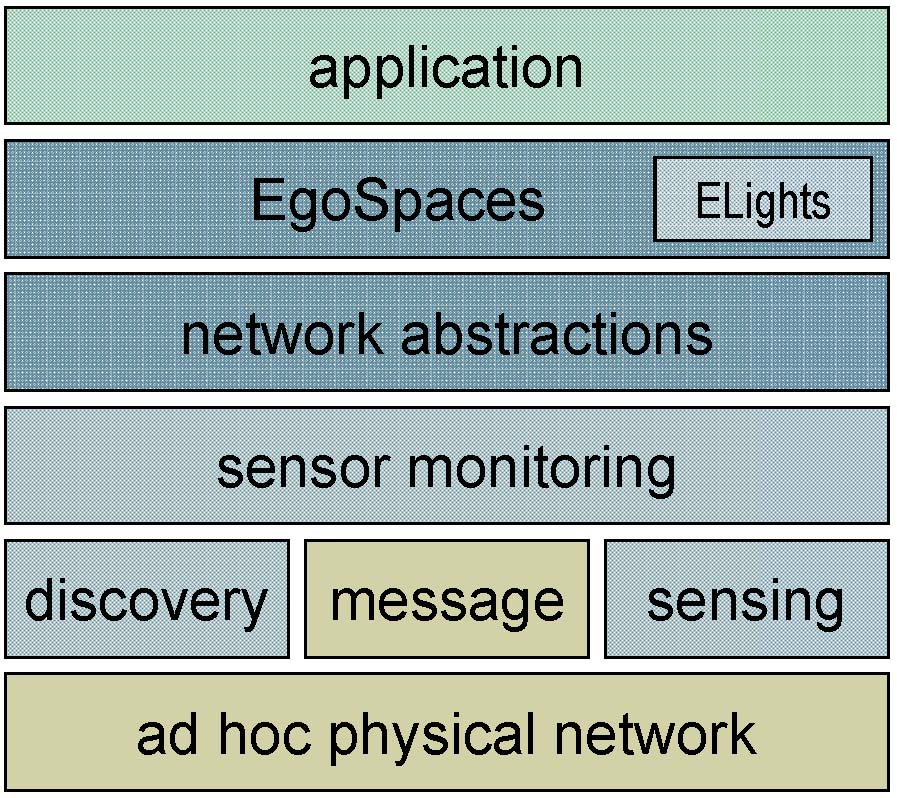
Figure 1: The EgoSpaces Architecture
EgoSpaces's fundamental concept is the view abstraction A view is a collection of relevant data (or context) items that are defined by meta data, the software agents that own the data, the hosts on which those agents are located, and the network paths that connect the application in question to the hosts holding the data items. The key novel aspect of the view abstraction is its provision of asymmetric coordination.
Publications
-
Julien, C., and Roman, G.-C., "EgoSpaces: Facilitating Rapid Development of Context-Aware Mobile Applications," IEEE Transactions on Software Engineering (to appear).
-
Julien, C., and Roman, G.-C., "Egocentric Context-Aware Programming in Ad Hoc Mobile Environments," inProceedings of the 10th International Symposium on the Foundations of Software Engineering (FSE-10), Charleston, SC (USA), November 2002, pp. 21-30.
-
Julien, C. and Roman, G.-C., "Active Coordination in Ad Hoc Networks," in Proceedings of the 6th International Conference on Coordination Models and Languages, Pisa (Italy), February 2004, pp. 199-215.
-
Julien, C., Payton, J., and Roman, G.-C., "Adaptive Access Control in Coordination-Based Mobile Agent Systems," Software Engineering for Large-Scale Multi-Agent Systems III, R. Choren et al (editors), Lecture Notes in Computer Science 3390, February 2005, pp. 254-271.
Download
The EgoSpaces prototype implementation is available for download as just a set of jar files or as a complete source distribution. Because EgoSpaces relies on a set of other software packages, the jar files for those packages are also required for proper functionality.
- Jar Files: egospaces.tar.gz
Download and unzip the file. It contains several .jar files that must be in your classpath to properly use any of the examples or to write your own EgoSpaces applications - Source: egospaces_src.tar.gz
This distribution contains all of the source in addition to the necessary .jar files. Again, be sure to include the jar files in your classpath to correctly use the examples or your own EgoSpaces applications - Documentation: egospaces_api.tar.gz
This file contains the javadocs for the EgoSpaces prototype implementation.
Examples
Source code for example applications will be posted here as they are available.
- File Share Application: fileShare.tar.gz
Download and unzip the file. You must also have the jar files from above and your classpath pointing to those jar files. FileShareAgent.java is the program here, it expects song files in the songs/ directory and, for each .mp3 file, the agent also expects a .txt file of the same name containing meta data for the song. An example of the structure for this file is available in songs (but not the corresponding mp3). If you use different songs, you'll have to change the code of FileShareAgent to reflect the different songs (by changing the songNames variable near the top of the java file). The eventual plan is to input these songs through an interface, but improving the interface is work in progress. - Puzzle Application: *coming soon*
Credits
EgoSpaces is the product of a research collaboration between Christine Julien and Gruia-Catalin Roman. Additional acknowledgement goes to Amy Murphy, Jamie Payton, and Gian Pietro Picco for their input and other contributions.