Electro-Thermal Bioinstrumentation Laboratory
Journal Papers and Conference Papers
In
Vivo Measurement of Left Ventricular
Volume in Mice using a Conductance Catheter
(with Dr. Pearce)
Transgenic
mice offer a valuable method to relate genes to various cardiac diseases, and
pressure-volume analysis is the gold standard for assessing myocardial function.
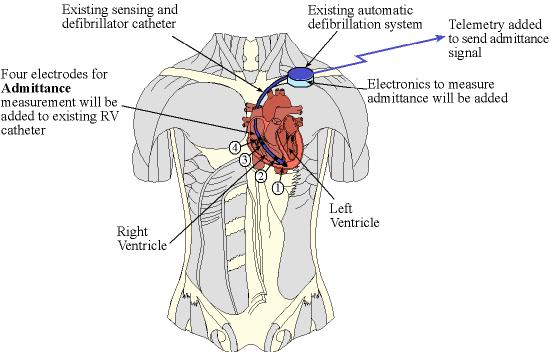
Cardiac volume can be estimated by a conductance catheter system.
Experimentally a four-electrode catheter is inserted into the mouse left
ventricle (LV) to generate an electric field and continuously to measure the
instantaneous conductance signal. Unfortunately, both blood and myocardium are
conductive, but only the blood conductance is wanted. Therefore, the parallel
myocardium contribution should be removed from the total measured conductance.
Research currently involves FEM numerical studies, instrumentation development,
real time measurement of phase using DSP, in vitro studies and
experimental verification in mice, dogs and humans.
Assessment
of Vulnerable Plaque using Thermal Properties
The overall goal of our project is to develop and evaluate an instrument
that takes a “thermal X-ray” of
the arterial wall. In particular, we propose to
combine sophisticated thermal modeling with precision instrumentation to develop
and evaluate a direct contact probe to scan the arterial wall to detect
vulnerable plaque. The scan will provide the thermal properties of the arterial
wall (namely thermal conductivity). The thermal property measurements will help
us predict the composition of the arterial wall underneath the thermistor-based
sensor. Vulnerable
plaques have more lipid and less fibrous tissue as compared to stable plaques.
There is a strong correlation between the structural components of
biologic tissue (fat, fiber, and calcium) and its thermal properties.
The thermal conductivity of a
material is its ability to transfer heat in the steady state. The proposed
technique is fundamentally different from thermography, which senses an
increased temperature caused by the increased metabolic activity of the plaque.
In contrast, our approach measures thermal conductivity, which in turn
will help to characterize the plaque. In
particular, we believe our instrument will be able to detect the large lipid
core that characterizes vulnerable plaque, and it may also help in determining
the thickness of the fibrous cap. If
successful, this device will provide a low-cost tool to assess the vulnerability
of plaque, as well as determine the response of the vulnerable plaque to therapy
directed towards improving plaque stability.
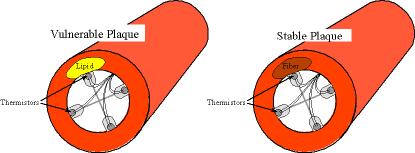
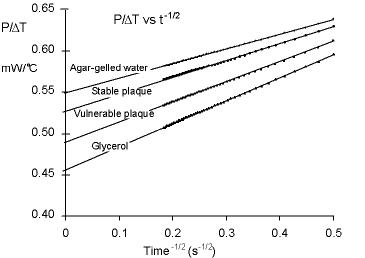
The rationale of our approach is based on the fact that fatty plaques
have a lower thermal conductivity as compared to thermal properties of fibrous
plaques. In particular, lipid has a thermal conductivity that is 60% less than
fibrous tissue. Therefore, we hypothesize that measurements of thermal conductivity will
provide information about the underlying makeup of the plaque, creating a
positive predictor for vulnerable plaque.
The method involves placing a thermal transducer in direct physical
contact with the endothelial surface of the artery under test, delivering a
small burst of heat as well as sensing the tissue temperature response.
The low amount of heat applied for 10-second duration will not have
long-term impacts on the plaque stability or vessel remodeling.
Hybrid
ΔΣ Modulation for High-Performance A/D Conversion (Robin Tsang)
The
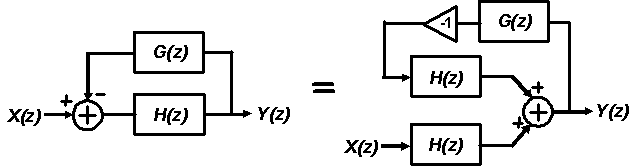
overall goal of this project is to develop a high-performance ΔΣ
modulator for analog-to-digital conversion. ΔΣ modulators take
advantage of noise-shaping and oversampling to achieve high resolution .
Noise-shaping is a collective term used to describe feedback systems that use
filtering to push quantization noise out-of-band while leaving in-band signals
unchanged. The main advantage of oversampling is it trades time for dynamic
range. Oversampling also relaxes analog component requirements such as opamp DC
gain and capacitor mismatch tolerances when compared to Nyquist rate converters.
Unfortunately, the overhead of oversampling limits the maximum achievable signal
bandwidth, making ΔΣ modulators attractive only in medium to low speed
applications.
High-Speed
High-Resolution Pipeline ADC (Byung Geun Lee)
The goal of this project is
to develop a low-power 12-bit 80MS/s pipeline analog-to-digital converter (ADC).
The proposed pipeline ADC
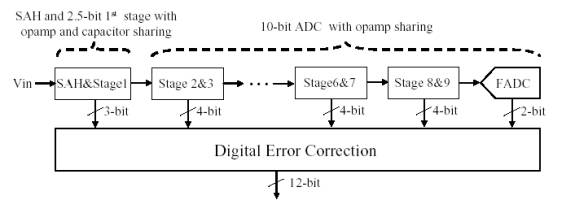
consists of the front-end sample and hold circuit (SAH), 2.5-bit first stage, 8
1.5-bit stages followed by 2-bit flash ADC. In order to reduce power
consumption, a number of opamp will be minimized using an opamp-sharing
technique. In addition, a capacitor sharing technique will be used for the SAH
and the first stage to further reduce power consumption by reducing the SAH
output load. The basic concept of opamp and capacitor sharing technique is
explained in Fig. 2. Since the feedback capacitors of the SAH are directly used
for the first stage MDAC operation, the sampling capacitors of the first stage
are not needed, thus reducing SAH output load capacitance almost by 50%.
Measurement of Thermal Convection Coefficient on the Endocardial Surface
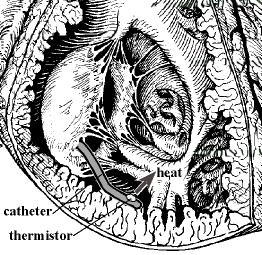
Cardiac ablation is a clinical technique to treat some cardiac arrhythmias using a RF probe from the endocardial surface. The RF probe delivers a controlled dose of heat to eliminate the errant electrical activity with as little damage as possible to the surrounding cardiac tissue. The effectiveness of this technique depends on accurate knowledge of the heat transfer between the inside surface of the heart and the adjacent flowing blood. A thermal technique is being developed to measure this important parameter.
My bioheat transfer research papers
Measurements of thermal properties, measurements of perfusion,
thermal modeling
Last updated September 12, 2009 Send comments to: Jonathan W. Valvano .