Spring 2012: EE 382N-4
Advanced Embedded Systems Architecture
Lab Assignment #1: Due Feb 20, 2012
AIM:
Develop an interrupt handler to measure the interrupt latency of Linux running on
the TLL platform using the I/O ports on the FPGA.
Note: This is a group lab exercise and
every group should demonstrate the working of the code on the board. A group
can have a maximum of 2 members.
Tutorial: device_driver + FPGA. <- Go through this link
first.
In this tutorial, an adder
is implemented on the FPGA. The user application code interacts with the adder
through the device driver.
Specification:
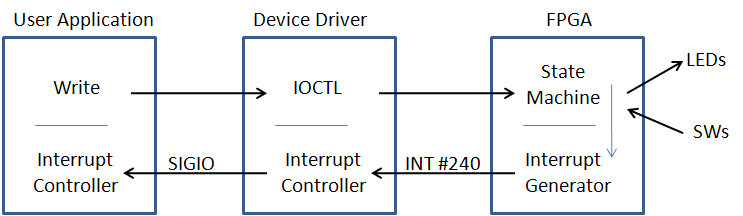
The functional diagram of the required setup is shown in the block diagram below:
1)
1)
The user application is the software
running on linux which in turn is running on the ARM processor.
a.
The application should send 10 pairs
of numbers to the device driver, issue the `add` command and once addition is
complete (for all 10 pairs), receive the results.
1.
However,
this should be implemented in a while loop (free running – without user
intervention).
2.
After
the `add` command is sent to the device driver, the loop will wait for the
interrupt from the FPGA and then issue the command to read the sum (#10).
b.
It will also host the interrupt
signal (SIGIO) handler to measure the latency from the time the input data are
sent to the FPGA to the time when the interrupt is received. You can use the C
function gettimeofday() to note the time.
c.
List the average, minimum and
maximum latency over 10 runs (run your program 10 times) as part of your
report.
d.
Discuss
your user application code, as part of your report.
2)
The device driver will be designed
as a loadable module, thus saving kernel memory.
a.
The device driver file adder.c (from
the demo) should be modified to host the interrupt functions.
b.
The interrupt functions will
initialize the required handlers, request for the specific interrupt to be
serviced etc.
c.
An example of the same setup for
GPIO (as against FPGA) is given below. Relate the following programs to lecture
9 for a better understanding of the code.
1.
main.c is the user application
2.
mx21_gpio.c is the corresponding device driver
3.
The
interrupt number for the GPIO pin used here is #107. The corresponding
interrupt number for the FPGA is #240.
4.
The MX21 board documentation at
/scratch/Documentation/MC9328MX21RM.pdf. Chapter 15 contains a note about the
GPIOs. The configuration details of the GPIO registers are given in that
chapter. This example configures the port PB10 as output and loopbacked to PB11
as input. You do not require these for the corresponding FPGA implementation.
d.
The above example
can be used as a reference to modify the adder.c program.
e.
Configure the
interrupt as rising edge sensitive.
f.
Notify the application code about
the occurrence of the interrupt using the
kill_fasync routine, similar to the one in mx21_gpio.c
g.
The `read` command to read the
results should be implemented as a separate read function (refer copy_to_user function) and not part of the
ioctl function. This will make the read process faster.
h.
Discuss
the changes that you made to the example device driver (adder.c), as part of
your report.
3)
The adder is implemented in the FPGA
(top.v)
a.
Receives data from the user
application through the device driver.
b.
FPGA is memory mapped starting from
0xD3000000 and 0xCC000000 of the ARM processor as stated in the docs.
c.
The top.v (from the demo) is the
verilog file that gets burned into the FPGA. Modify it
1.
to
receive, store and add the 10 pairs of numbers on the reception of an `add`
command,
2.
to
raise the interrupt signal when the addition is complete,
1.
MZ_CPLD_MISC14
is the signal corresponding to interrupt #240, in top.v
3.
to
make the interrupt signal a pulse which will go back to zero state
automatically after a certain delay,
4.
to
have one of the DIP switches (or address 0xCC000000 has the value ‘1’ in it) on the board to act as the enable for
the interrupt,
1.
Interrupts
should not be generated when the DIP switch is off (or when 0xCC000000 has
say ‘2’ written into it)
2.
DIP_SW
in top.v is the signal corresponding to the switches.
3.
In
top.v, 0xCC000000 – 0xCFFFFFFF is the bigger of the memory mapped regions
corresponding to the FPGA, the other one is 0xD3000000 – 0xD3FFFFFF
5.
to
toggle an LED whenever address 0xD3000004 is accessed indicating the data
arrival from the ARM processor (optional), and
6.
to
map the interrupt pulse to another LED on the board for observation (optional).
d.
Discuss the changes to top.v, as
part of your report.
Deliverables:
The code (user application, device driver, Makefile, top.v) and your report
must be zipped and submitted through the assignment section of Blackboard. Please
refrain from sending them as attachments through email.