Jonathan Walker Valvano – one messy office, five fun classes to teach, eleven textbooks,
the best job on the planet spanning five decades, thousands of mistakes but a few successes,
thousands of brilliant students, two hundred thousand on-line students, and millions of YouTube views;
lifelong explorer with one mind, one body, one soul, one lovely horse with beautiful spots, two free-spirited cats,
countless friends, three wonderful children;
always striving to make the world a better place.
You can live 40 days without food, 4 days without water, 4 minutes without air,
but I wouldn't last 4 seconds without the love and companionship of my friends and family.
His soldering iron is currently plugged in at his office at EER 5.820 here at The University of Texas at Austin.
Now that this pandemic craziness is over, stop by and say hello. As always, please be safe and take care of each other.
History will remember these times, let history remember us well.
Robot Systems Learning Kit was completely redesigned.
The robot is runs on either the TM4C123 or MSPM0 LaunchPad. The ultimate goal of the learning kit is to design, build, and test a robot system capable of solving complex tasks. Example challenges include exploring a maze,
and racing autonomously. However, it is not the final robot that matters, but
the educational journey that discovers a wide range of engineering principles
along the way. Rather than just providing the robot kit and a challenge to
solve, this curriculum follows an educational road map that intentionally
exposes deep learning along the way.
More information on RSLK
Embedded System
Courses I teach at the University of Texas
ECE406 Introduction to Computers
This is the first course in computing for students of computer engineering and
electrical engineering. The objective is to provide a strong foundation that a
serious student can build on in later courses across the spectrum of computer
science and engineering.
ECE419K Introduction to Embedded SystemsSyllabus
Spring 2026
I will teach ECE419H Spring 2027.
Spring 2026 PCB Camp Undergraduate
class: ECE419K/ECE419H students discover
how
the computer interacts with its environment. Students have hands-on
experiences of how an embedded system could be used to solve EE
problems. The analog to digital converter (ADC) and digital to analog
converter (DAC) are the chosen mechanism to bridge the CE and EE
worlds. EE concepts include Ohms Law, LED voltage/current, resistance
measurement, and stepper motor control. CE concepts include I/O device
drivers, debugging, stacks, FIFO queues, local variables and
interrupts. The hardware construction is performed on a breadboard and
debugged using a multimeter. Software is developed in assembly and in C
for a
ARM
Cortex-M MSPM0G3507 microcontroller. Prerequisites: ECE406 or ECE406H
with a grade of at least C-.
ECE412H/ECE419H Combined Experience
During the spring 2027 semester, ECE offers special sections of ECE412H and ECE419H in an integrated manner.
To join the adventure you must register for both ECE419H and ECE412H.
ECE382V
Technology for Embedded Internet of Things
Syllabus
I will teach ECE382V again in Fall 2027.
Graduate class: Internet of Things (IoT) is ubiquitous in the computing world.
Connected devices allow remote data acquisition, distributed processing,
and remote actuation. The focus of this class will be low-level
technology to implement IoT devices. By exposing fundamental
operational behavior, students, when facing a design problem,
will be empowered to either select an appropriate existing technology,
or to develop new technologies.
Prerequisites: ECE445L, programming in C.
What we built in 2020:
In response to the urgent local and global requirement for essential patient-focused medical equipment,
a team of faculty, researchers, and students at UT Austin, Dell Medical School
and the UT Health San Antonio developed a low-cost, reliable and effective
medical breathing device — the Automated Bag Breathing Unit (ABBU)
— a ventilator-like device that can be utilized when conventional ventilators
are not readily available to provide life-saving support for patients with COVID-19
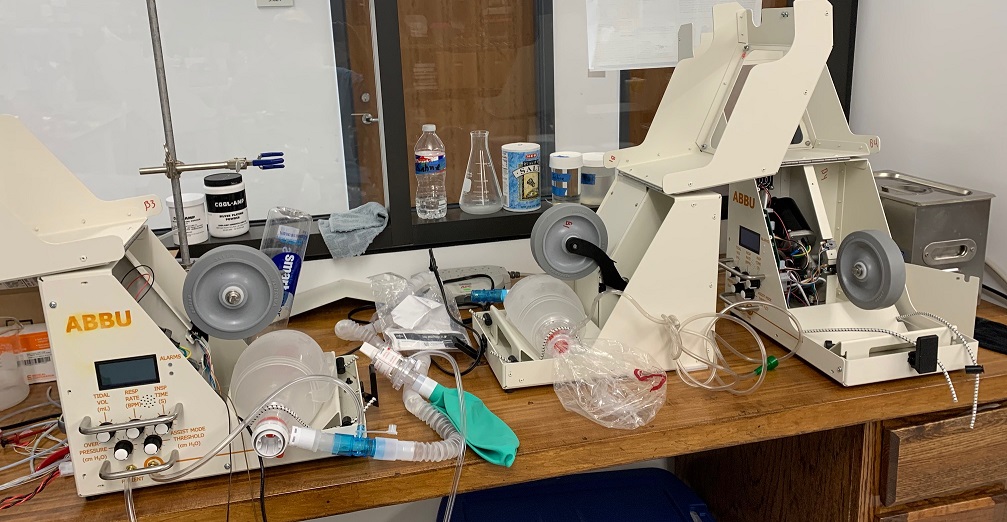
and other respiratory illnesses. The figure below shows three ABBUs in my research lab in EER5.822.
EE385J.17/BME384J.2
Real-Time Embedded Instrumentation, last taught Spring 2009 Graduate lab class:
Instrumentation and real time
software. Prerequisites: Microcomputer interfacing, C, op amps,
differential equations.